Spring Festival 春节 - Chinese New Year 农历新年


The Chinese believe the heart of the family resides in the kitchen. So certain food are eaten during this special time of celebration. It is a time for feasting, family reunions and fun!

Each year, Asians throughout the world spend weeks preparing for the 15-days of celebration, officially called the Spring Festival. Chinese New Year (CNY) is a time for families. Before this day, weeks will be spent on cleaning the house in order to usher in the new year. Activities from painting of the interiors, doors, throwing away spoilt or broken or old stuffs.

Eating of special foods prepared or cooked before this day follows. The celebration lasted for a full 15 days. They eat food of symbolic significance and such festive foods range from mandarin oranges, harmony trays filled with lychee and nuts and other snacks to symbolize good fortune. Fish is the other 'lucky food' which is enjoyed the night before Chinese New Year.

In 2011, the CNY will be celebrated on the 3rd February 2011. This day marks the first day of the first Chinese lunar month. Coincidentally, the western valentines' day is also on this day!


10 Special CNY Food and its symbolism:
1. Serve the chicken whole = Family togetherness.
A proper beginning and end to the year and a wholeness of life on earth

2. Serve Noodles = A long life (it's bad luck to cut them)

3. Lettuce = Rising Fortune
The Cantonese word for lettuce sounds like rising fortune,(Cantonese word for lettuce saang choi, sounds like plentiful wealth). Hence, it is good to serve a lettuce wrap filled with other lucky food.

4. Serve Clams and Oysters = Wealth
The opening of the shell represents a fresh beginning for the new year. It resembles bouillon, the ancient coins

5. Mushrooms = Prosperity
They grow quickly.

6. Shrimp = Happiness
The Cantonese word for shrimp is "ha," which sounds like the word for laughter, so it represents happiness.

7. Serve Spring Rolls = Wealth
They resembles Gold Bars

8. Luck, Wealth, Abundance
Tangerines = LUCK
Oranges = WEALTH
Pomelos (Grapefruit)
The Chinese word for Pomelo = 'to have' which makes this fruit signifies ABUNDANCE

9. Fish = Wish & Abundance
The word for fish, "Yu," sounds like the words both for wish and abundance.
On New Year's Eve it is customary to serve a fish at the end of the evening meal, symbolizing a wish for abundance in the coming year. For added symbolism, the fish is served whole, with head and tail attached, symbolizing a good beginning and ending for the coming year.

10. Sweet, steamed cakes, Sticky Rice Cake = Rich, Sweet Life, Rising Abundance
Sweetness symbolizes a rich, sweet life, while the layers symbolize rising abundance for the coming year.
The round shape signifies family reunion.


How the food sounds matters :)
Foods that are avoided:
Melon — The word for melon is "gua," which sounds like death (in cantonese)
Tofu — The "fu" rhymes with negativity.


funny pictures


Chinese Calendar=农历 nónglì


The Chinese calendar is a lunisolar calendar formed by combining a purely lunar calendar with a solar calendar. Among Chinese, the calendar is not used for most day to day activities, but is used for the dating of holidays such as Chinese New Year (Spring Festival) and the Mid-Autumn Festival and for divination, including choosing the most auspicious date for a wedding or the grand opening of a building.

The primary use in day to day activities is for determining the phase of the moon, which is important for farmers and is possible because each day in the calendar corresponds to a particular phase of the month.


funny pictures

Hong Bao红包 : 压岁钱 yāsuì qián

A red envelope or red packet (word by word, it is Hong Bao in Mandarin 红包). It is a monetary gift which is given during holidays or special occasions and of course, the chinese new year. The word 压岁钱 yāsuì qián means "money warding off evil spirits", and was believed to protect the elderly from sickness and death.

Red envelopes are mainly presented at social and family gatherings such as Chinese weddings. The red color of the envelope symbolizes good luck and is supposed to ward off evil spirits. The amount of money contained in the envelope usually ends with an even digit, in accordance with Chinese beliefs; for instance 88 and 168 are both lucky numbers.

During Chinese New Year, hong bao are typically given to the unmarried by the married, regardless of age. Traditionally, the red envelope is not supposed to be opened until the Chinese New Year festivities are over; otherwise, bad luck would befall the recipient for the whole year.


This is Singapore's largest hongbao lantern ever made and is displayed at the HarbourFront Centre, North Atrium. This 20 feet, nine-layer lantern is made entirely from hongbaos. 
Photo Credit: Neo (www.singaporedailyphoto.com)


funny art


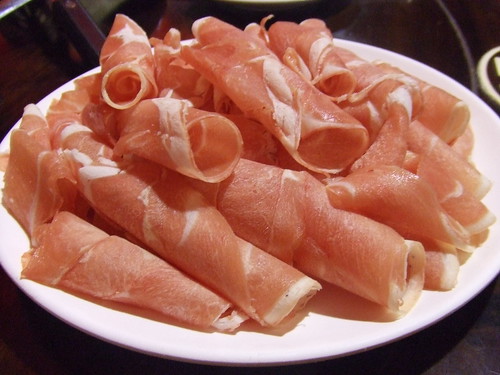
涮羊肉火锅 huǒ guō = Steamboat (hot pot)

Originally uploaded by Tina @ TW

Steamboat or Hot pot is 火锅 huǒ guō consists of a simmering metal pot of stock at the center of the dining table.

These thinly sliced mutton are also called instant-boiled mutton 涮羊肉 and are mostly found in the Inner Mongolian (better known as Mongolian Fire Pot). 涮羊肉锅 is created in the Yuan Dynasty and these fresh non-greasy yet tender mutton are specially chosen from the back, rear legs of the sheep. 

While the hot pot is kept simmering, ingredients are placed into the pot and are cooked at the table. Typical hot pot dishes include thinly sliced meat, leafy vegetables, mushrooms, wontons, egg dumplings, and seafood. The cooked food is usually eaten with a dipping sauce. In many areas, hot pot meals are often eaten in the winter.

涮羊肉 (涮羊肉火锅),是一种将羊肉(后来也增加了肥牛等)、蔬菜、豆腐等食材放到火锅中,用沸水涮熟后沾小料食用的菜肴。

北京食品 | 火锅 | 羊肉 | 食疗


funny art


Learning Chinese - Benefits


Originally uploaded by zannnielim
Chinese is a very unique language which has a long historical background. Each character corresponds to a single unique pictorial symbol, syllable and it is standalone.

One must visualize and memorize the shape, syllable and meaning of the word which the learning process activates and stimulates the senses on sight, hearing and appreciation. In return, the learner is trained to have good pictorial and audible memories, imaginations, observations, judgments and understandings. It activates and stimulates most and fastens the growth of the brain cells.

It is recommended to begin learning Chinese at the very young age when the brain cells are growing and building. The uniqueness of Chinese make the users read, speak and sometimes write faster than other languages. In return, it shortens the time for transferring messages, knowledge and also work can be completed within a shorter time.

---

Paint Avant-Garde

BNXS 

The earliest Chinese characters - Shell & Bone Inscription

The earliest Chinese characters, called Shell and Bone Inscription, were pictographic symbols carved onto turtle shells (and animal bones) by Shang Dynasty people.


That's more than three thousand years ago! It was said that the Chinese characters were invented by a Master Chronicler of History for the Yellow Emperor, in the forms of figures of birds, animals, and objects.  The block-shaped characters we use today are the result of constant innovation and improvements by many people in different historical periods, and are gradually evolved from the pictographic symbols of the Shell and Bone Inscription, and the Bronze Inscription. 

Wanna know why 'moon' is the radical now used for 'flesh/meat' such as names of body parts? Yes


---

Paint Avant-Garde

News


---

Paint Avant-Garde

长城 Cháng chéng=Great Wall

Qin Shi Huang conquered all opposing states and unified China in 221 BC, establishing the Qin Dynasty. His intention was to impose centralized rule and prevent the resurgence of feudal lords, he ordered the destruction of the wall sections that divided his empire along the former state borders.

To protect the empire against intrusions by the Xiongnu people from the north, he ordered the building of a new wall to connect the remaining fortifications along the empire's new northern frontier.

There are no surviving historical records indicating the exact length and course of the Qin Dynasty walls. Most of the ancient walls have eroded away over the centuries, and very few sections remain today.
It is estimated that over 1 million workers died building the wall.

Here is a video about the 长城 Cháng chéng=Great Wall

Great Wall Of China, Badaling Pass, Near Beijing - These bloopers are hilarious

---

Paint Avant-Garde

Spring Festival 春节 - Chinese New Year 农历新年

One Chinese belief: The heart of the family resides in the kitchen.
Do you know why certain food are eaten during this special time of celebration?

Chinese New Year is a time for feasting, family reunions and fun! Each year, Asians throughout the world spend weeks preparing for the 15-days of celebration, officially called the Spring Festival.

Chinese New Year (CNY) is a time for families. Before this day, weeks will be spend cleaning the house in order to usher in the new year. Activities from painting of the interiors, doors, throwing away spoilt or broken or old stuffs. Then on this day, eating of special foods prepared or cooked before this day. The celebration lasted for a full 15 days. The symbolic significance of festive foods from mandarin oranges, harmony trays filled with lychee and nuts and other snacks to symbolize good fortune. Fish is the other 'lucky food' which is enjoyed the night before Chinese New Year.

In 2011, the CNY will be celebrated on the 3rd February 2010. This day marks the first day of the first Chinese lunar month.


10 Special CNY Food Symbolism:
1. Serve the chicken whole = Family togetherness.
A proper beginning and end to the year and a wholeness of life on earth

2. Serve Noodles = A long life (it's bad luck to cut them)

3. Lettuce = Rising Fortune
The Cantonese word for lettuce sounds like rising fortune,(Cantonese word for lettuce saang choi, sounds like plentiful wealth). Hence, it is good to serve a lettuce wrap filled with other lucky food.

4. Serve Clams and Oysters = Wealth
The opening of the shell represents a fresh beginning for the new year. It resembles bouillon, the ancient coins

5. Mushrooms = Prosperity
They grow quickly.

6. Shrimp = Happiness
The Cantonese word for shrimp is "ha," which sounds like the word for laughter, so it represents happiness.

7. Serve Spring Rolls = Wealth
They resembles Gold Bars

8. Luck, Wealth, Abundance
Tangerines = LUCK
Oranges = WEALTH
Pomelos (Grapefruit)
The Chinese word for Pomelo = 'to have' which makes this fruit signifies ABUNDANCE

9. Fish = Wish & Abundance
The word for fish, "Yu," sounds like the words both for wish and abundance.
On New Year's Eve it is customary to serve a fish at the end of the evening meal, symbolizing a wish for abundance in the coming year. For added symbolism, the fish is served whole, with head and tail attached, symbolizing a good beginning and ending for the coming year.

10. Sweet, steamed cakes, Sticky Rice Cake = Rich, Sweet Life, Rising Abundance
Sweetness symbolizes a rich, sweet life, while the layers symbolize rising abundance for the coming year.
The round shape signifies family reunion.


How the food sounds matters :)

Foods that are avoided:
Melon — The word for melon is "gua," which sounds like death (in cantonese)
Tofu — The "fu" rhymes with negativity.

---

Paint Avant-Garde


Chinese Arts=中国艺术 刺绣=Chinese Embroidery


广西靖西:刺绣


Chinese handicrafts are very beautiful and popular with distinctive national features.

From furnishings to household items, many have distinct ethnic characteristics. Handicrafts include the following categories: Ceramic, woven handicraft, sculpture handicraft, lacquer work, metal handicrafts and woodwork.


---

Paint Avant-Garde

Twitter Delicious Facebook Digg Stumbleupon Favorites More

 
Design by Free WordPress Themes | Bloggerized by Lasantha - Premium Blogger Themes | Facebook Themes